1-Bromodecane: A Deep Dive into a Vital Alkyl Halide
Historical Development of 1-Bromodecane
A full century separates today’s chemistry labs from those where organic halides like 1-bromodecane became household names. Back in the early 1900s, chemists craved simple, predictable building blocks for organic synthesis. They welcomed straight-chain haloalkanes, which turned up in early explorations of alkylations and nucleophilic substitutions. 1-Bromodecane first entered wider discussion due to its balance between volatility and chain length. Its successful use as an intermediate caught the eye of researchers in Europe and North America early on. Over the decades, commercial-scale bromination advanced, and so did the consistent supply and purity levels for this compound. Today’s manufacturers continue tweaking old methods but owe much to the chemistry pioneers who first mapped out its core transformations.
Product Overview of 1-Bromodecane
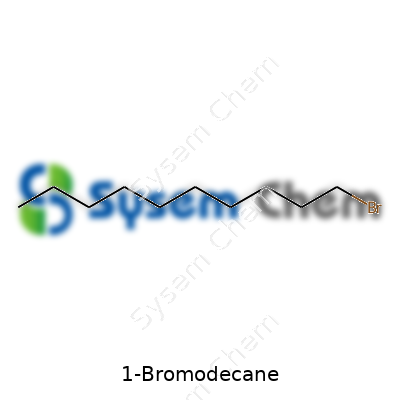
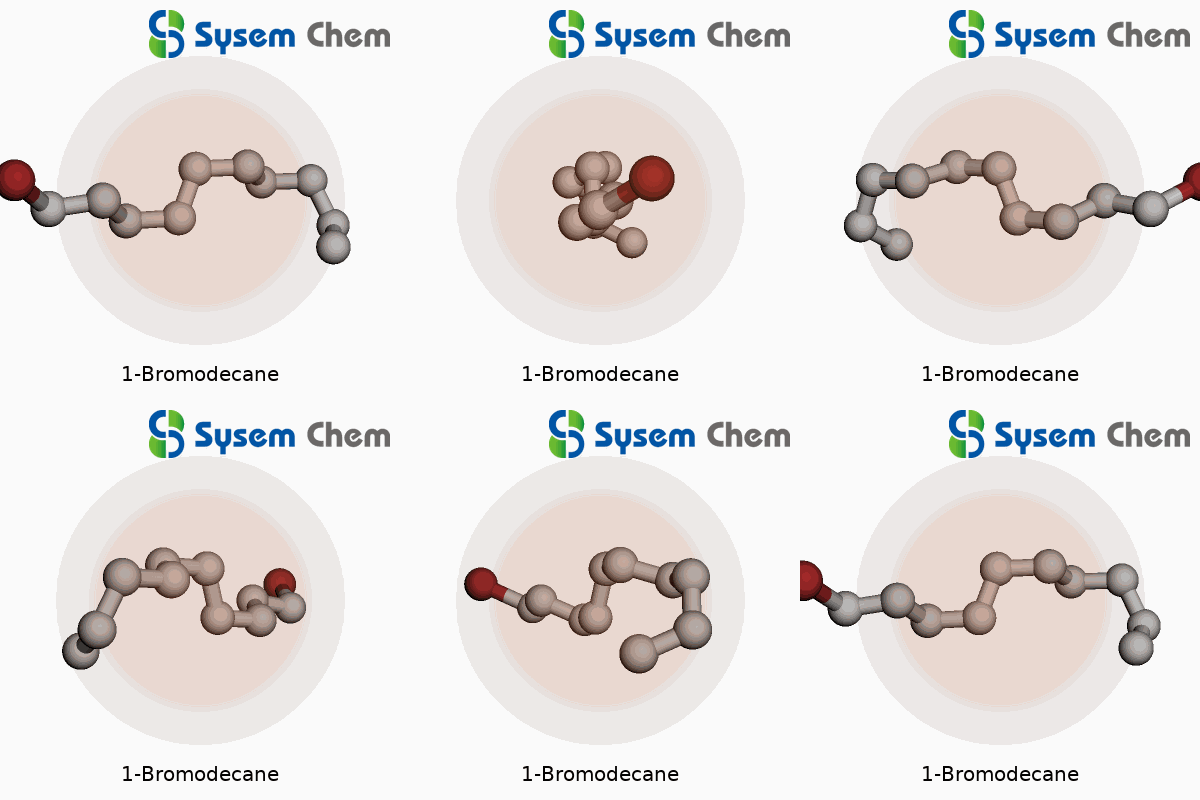
1-Bromodecane stands as a straight-chain, saturated alkyl bromide, holding ten carbon atoms with a bromine atom locked onto the terminal carbon. This molecular structure lets it serve as a key building block, especially for those needing to introduce a decyl group into larger molecules. From my time working in university chemistry labs, I found this compound reliable enough to handle repetitive experiments without surprises. Suppliers tag it as a specialty intermediate, intended mainly for industrial synthesis rather than direct consumer use. It arrives as a clear, colorless liquid, typically offered in dark glass bottles to keep it stable and prevent light-triggered reactions.
Physical & Chemical Properties
The oily consistency feels familiar to those who handle higher alkanes. 1-Bromodecane’s boiling point hovers near 241°C, and its melting point usually lands around −6°C. It greets nose with a faint organic odor, far less aggressive than shorter alkyl bromides. Its density tips the scale at just under 1.1 g/cm³ at room temperature, making it noticeably heavier than water. In solubility terms, dropping this into water won’t get far, but organic solvents—especially ether and chloroform—blend well with it. The presence of the bromine atom not only boosts its reactivity in substitutions but also makes it more responsive to nucleophiles. Electrical insulation properties remain high due to its nonpolar backbone, though the bromine ensures it finds use in polar reactions as well.
Technical Specifications & Labeling
A reputable 1-bromodecane shipment always arrives labeled with CAS number 112-29-8. Professional suppliers specify purity levels, often above 98%, and detail any residual solvents in their certificates of analysis. Storage recommendations point toward cool, dry spaces in tightly sealed vessels, emphasizing the need for chemical-resistant gloves and splash-proof goggles upon handling. Labels note the risk phrases associated with skin and respiratory irritation. Specifications matter—a small trace of water or chlorine-laden byproducts can derail sensitive multi-step reactions. Having worked with both off-brand and premium suppliers, I am quick to double-check technical sheets for both purity and stabilizer content before usage.
Preparation Method
Industrial setups rely on free-radical halogenation, starting usually with decane and passing gaseous bromine over it, sometimes with UV light as an initiator. On lab scales, the conversion of 1-decanol into 1-bromodecane via phosphorus tribromide remains a classic. Thin white fumes—hydrogen bromide—warn that ventilation is crucial. Advanced synthetic chemists sometimes use N-bromosuccinimide (NBS) for a gentler approach, especially when purity and selectivity come first. Careful temperature control spells the difference between a clean product and a messy mixture of byproducts. From my own bench-top runs, isolating the product by careful distillation often makes the difference between a test-tube triumph and a disappointment.
Chemical Reactions & Modifications
The primary role of 1-bromodecane centers on being a strong alkylating agent. Students spot its usefulness in nucleophilic substitution reactions—think SN2 mechanisms, where anything from simple amines to thiolates attack the carbon bearing bromine, leading to new C-N or C-S bonds. Chemists interested in Grignard techniques turn to it for producing decylmagnesium bromide, a superb way to inject a decyl chain onto carbonyl compounds. The presence of the terminal bromine enables easy further modification: hydrolysis yields the alcohol, or elimination reactions introduce unsaturation. Plenty of specialty surfactants and lubricants owe their unique tail groups to 1-bromodecane’s convenient reactivity.
Synonyms & Product Names
Walk into any chemical storeroom, and one might spot several product names for this compound: decyl bromide, n-decyl bromide, or 1-decbrom. Each points to the same substance. Scientific publications usually refer to it by IUPAC standards, but industry and suppliers stick to the common names, sometimes attaching their proprietary brand. Import/export paperwork leans on that CAS registry number for clarity.
Safety & Operational Standards
Handling halogenated compounds brings inherent risks. 1-Bromodecane can irritate skin and eyes, and inhalation overexposure triggers headaches or even longer-term central nervous system symptoms. Engineering controls like fume hoods and splash-resistant lab coats form the frontline of protection. Training matters: I remember graduate lab stints where lax care resulted in poor air quality, leading to minor but avoidable exposures. Industry standards call for chemical splash goggles, nitrile gloves, and ready access to eyewash stations. Disposal happens only under strict protocols—halogenated solvent waste must never mix with general organic bins, and incineration needs permitted facilities to avoid releasing brominated dioxins. Clear procedures and refresher training help prevent mishaps.
Application Area
Findings from both research and industrial experience highlight 1-bromodecane’s main value as a chemical intermediate. Surfactant development relies on the straight-chain decyl group, while custom lubricants benefit from its compatibility with longer hydrocarbon bases. Specialty pharmaceutical synthesis also taps its ability to transfer the decyl group in tailored molecules. A lesser-known usage appears in phase-transfer catalysis, where it acts as a hydrophobic chain source for designing tailor-made catalysts. Finally, a handful of laboratory educational kits feature it for demonstrating classic organic reaction mechanisms, giving students a taste of practical synthesis.
Research & Development
Recent years bring breakthroughs in greener manufacturing and better reaction efficiency. Teams in both industry and academia tackle selective mono-bromination, hoping to maximize yield and reduce waste. I’ve seen patent filings that apply flow chemistry approaches, using continuous bromine feed and tight reactor monitoring for improved consistency. Analytical chemists pay special attention to trace contaminants, working to prove purity with high-performance liquid chromatography and spectroscopy. Trend watchers keep an eye on efforts to repurpose brominated hydrocarbons in biodegradable surfactant design, pushing for environmental sustainability alongside industrial utility. Younger researchers tackling surfactant and polymer chemistry often pick 1-bromodecane for baseline studies—its simplicity, reactivity, and reliability set the stage for more intricate innovations.
Toxicity Research
Concerns over acute and chronic toxicity run high among regulatory bodies tracking organic bromides. Animal studies show that direct exposure in high doses irritates tissue, and repeated inhalation can influence liver enzyme pathways. The U.S. Environmental Protection Agency, as well as the European Chemicals Agency, push for tighter control over disposal and exposure, and for monitoring workplace air quality. From parametric health studies, 1-bromodecane rarely causes acute danger at typical lab concentrations but could pose chronic hazards with cumulative exposure. Environmental toxicologists keep testing for persistence, since brominated alkanes can resist natural breakdown in soil and water. For those reasons, most universities and companies maintain rigorous recordkeeping of usage and waste generation.
Future Prospects
Global demand for specialty chemicals and surfactants still rises, promising continued relevance for 1-bromodecane. As green chemistry principles push forward, synthetic methods that swap out hazardous reagents or cut down on waste hold special commercial appeal. Low-toxicity, biodegradable surfactant development might draw on modified 1-bromodecane as a starting point. Regulatory shifts remain on the horizon—tighter controls will steer industry toward safer use and improved worker training. Automation and machine learning look set to optimize manufacturing, with real-time monitoring ensuring fewer accidents and better yields. In my own work with specialty intermediates, I expect future teams to view 1-bromodecane both as a tried-and-true staple and a candidate for ongoing reinvention in the quest for safer and more responsible chemistry.
Inside the world of specialty chemicals, every compound carries its own story. 1-Bromodecane might not be a household name, but it does more work than most folks realize. This long-chain alkyl bromide brings a hefty decyl group and a reactive bromine atom wherever it goes, and people in labs have figured out how to pull some smart tricks with it.
Building Blocks for Chemistry
Organic chemistry thrives on simple starting points that get transformed into something new. 1-Bromodecane fits the bill as a strong alkylating agent. I spent some time working alongside synthetic chemists who leaned on compounds like this to attach long chains onto other molecules. It comes down to getting that bromine to swap places with another group. You end up with products that act as stepping stones for everything from surfactants to specialty lubricants.
Making Surfactants and Quaternary Ammonium Compounds
Look at a bottle of shampoo or a jug of industrial cleaner, and you'll find the fingerprints of substances built with precursors like 1-Bromodecane. Chemists react it with nitrogen compounds, stirring up quaternary ammonium salts with the right kind of oily chains to grab grease and dirt. Some of these products work well in water, breaking down messes on everything from dirty boots to beakers in the glassware washroom. With quats, the length of the carbon chain shapes how aggressively they tackle grime or interact with microorganisms.
Processing and Material Science
Polymers and plastics rarely emerge straightforward from their raw monomers. Modifiers, stabilizers, and additives make or break their performance. Some specialty plastics benefit from long alkyl chains introduced during processing, and here, 1-Bromodecane steps up. Blending it into a reaction can boost flexibility or keep a material from sticking where designers don’t want it to. This isn't the sort of shift that jumps out to the consumer, but it matters for manufacturers aiming for quality and consistency.
Pharmaceutical and R&D Applications
New drugs and advanced materials begin on the benchtop. It’s not all atom smashers and laser beams—sometimes, it’s the right organic halide making the difference. In the lab, 1-Bromodecane works as an intermediate in creating molecules with long hydrophobic tails. Scientists use it to test theories about how molecules interact with cell membranes or proteins. During my time in academic labs, I watched postdocs test derivative after derivative, all starting with these small, transformative reactions.
Safety and Environmental Considerations
Handling halogenated compounds calls for some care. Inhalation or skin contact raises health concerns. The folks working with 1-Bromodecane don gloves, keep good ventilation, and respect the rules for chemical disposal. Regulations push companies and scientists to swap out hazardous starting points whenever possible, but for some jobs, there’s no easier replacement on the market just yet.
Future Directions and Responsible Use
Public pressure and tighter restrictions urge industry to rethink chemistry that builds up persistent waste. Alternatives do exist, but every swap means weighing function against safety. The best hope lies in smarter design—making the same sorts of physical properties with fewer side effects down the chain. Balancing performance, safety, and environmental stewardship keeps folks in the lab and the boardroom thinking creatively, searching for better tools to solve tomorrow’s problems.
Trust in Chemistry Starts with Accurate Formulas
The molecular formula of 1-Bromodecane is C10H21Br. This one line opens up an entire world of chemical understanding. At first glance, it looks like just a string of letters and numbers, but this simple combination stands for so much more. A formula like C10H21Br tells chemists exactly what they're working with, from lab work to industrial production, guiding every calculation and reaction.
Clear Structure, Reliable Applications
Every time I see a chain of ten carbon atoms, as in decane, I remember the early days in organic chemistry. Details matter. Swapping even one hydrogen out for a bromine atom changes how the compound behaves. That’s what happens with 1-Bromodecane: a straight-chain decane, transformed by a single swap at the end of the chain. No ambiguity. The result, C10H21Br, stands for a substance with a distinct profile — not just on paper but in real experiments and commercial processes.
Practical Impact on Science and Industry
Why focus so much on these molecular details? The answer shows up in real-life work. I’ve seen teams troubleshooting laboratory fails because someone underestimated how a bromine atom rule affects reactivity. Brominated compounds like 1-Bromodecane often show up as intermediates during the production of other chemicals or as starting points for pharmaceuticals and agrochemicals. Bromine’s electronegativity makes this molecule a useful tool in creating carbon–carbon and carbon–nitrogen bonds, which links directly to how medicines and materials are made.
Any lost count or typo in the formula leads to mistakes. Chemical engineers rely on these formulas for their mass balances and hazard assessments. Missteps mean wasted resources and higher risks. C10H21Br is more than a label. It’s a guarantee that work moves forward based on sound science, with safety and sustainability top of mind.
Transparency Supports Safety and Trust
Years in the lab taught me: transparency and clarity protect people. If a shipment arrives labeled only as "bromodecane," there’s a problem. 1-Bromodecane differs from other isomers, so the specifics in labeling matter for safety data sheets and compliance with environmental rules. Health risk assessments rely on the exact molecular composition. Even a slight change in a structure means a big shift in hazards or handling protocols. When regulators and companies know they’re dealing with C10H21Br, they have the right foundation for safe storage, transport, and use.
Solutions for Improvement in Communication
The solution calls for careful education and culture around detail orientation. Universities and companies ought to train new scientists to double-check not just procedures, but also the accuracy of the formulas on every document. Digital tools and barcoding systems help keep records aligned and cut down on human error. It pays off not just in efficiency, but also in the public’s right to informed choices about what’s in their environment.
Building public trust and advancing scientific progress begins with the small, clear step of getting the formula right: C10H21Br for 1-Bromodecane. That’s how chemistry works at its best.
Recognizing the Risks
Anyone who has spent any time working in a chemistry lab or an industrial setting gets told: know what’s in your bottle. 1-Bromodecane comes off as a simple clear liquid, but its hazards hide beneath the surface. Skin absorbs it easily, and it leaves behind irritation or worse if someone splashes it and fails to wash. Inhalation can send strong odors snaking up the nose — headaches and dizziness follow if ventilation doesn’t keep up. Repeated exposure starts challenging liver and nervous system health. I’ve seen firsthand how a forgotten glove or carelessly uncapped flask sets the stage for an emergency. These stories spread quickly among colleagues because they carry a lesson common sense teaches best: respect even routine chemicals.
Personal Protective Equipment Isn’t Optional
Start with gear that fits well and holds up to liquid. Nitrile gloves form a barrier most folks can trust. Lab coats or chemical aprons keep clothes clean and skin protected—nobody likes an unexpected rash halfway through a shift. Eye protection does more than check a box: a single drop in the eye sends someone to the eyewash station or worse, the hospital. A sturdy set of goggles beats reading material safety data sheets from an ER bed. Some jobs call for face shields if there’s real risk of splashing. Don’t skimp on shoes; closed toes stop puddles and broken glass from getting personal.
Ventilation Means Clean Breathing
Breathing shouldn’t be a gamble. If you’ve ever entered a room thick with sharp chemical smells, that’s the nose’s way of saying the air is already tainted. 1-Bromodecane vaporizes faster than you’d guess, especially with heat. I tell new techs: always work in a fume hood or with solid local exhaust fans. Small labs often buy cheap fans that barely move air, but during a late-night session, nobody complains louder than an overworked nose and lungs. The less you smell, the less you’re exposed.
Handling and Storage
Uncapping a bottle should feel deliberate, not rushed. Spills happen fast, so I always keep absorbent pads and neutralizers close by. My old supervisor insisted on double-checking labels—one slip and someone mistakes 1-Bromodecane for a less hazardous solvent. Store it in tightly closed containers away from light and heat, both of which speed up decomposition and evaporation. Far too many labs pile chemicals together on a shelf just to save space. I’ve seen incompatible substances stored side by side—one earthquake or accident later, cleaning up means wearing full hazmat gear.
Emergency Response: Actions Matter
Emergencies expose gaps in training. Wash stations and showers need to stay accessible—any bottles or equipment in the way turn seconds into minutes. If eyes or skin get exposed, rinse immediately with water and strip off contaminated clothing. Most of those who hesitated, worried about embarrassment, faced bigger health problems down the line. Spill kits should be more than a checklist item; someone should know exactly what’s inside and how to use it fast. Fire extinguishers nearby bring peace of mind, particularly since 1-Bromodecane flares up if handled alongside incompatible chemicals.
Building Safer Habits
Learning from mishaps changes practices permanently. Sharing clear instructions, not just printed signs, motivates people to change gloves, close bottles snugly, and stay alert. Turnover among staff leads to knowledge gaps, so regular training sessions become more useful than almost any new gadget. Some say these steps slow down work. I’ve seen projects speed up, not stall, for teams that commit to safety every step of the way.
A Closer Look at 1-Bromodecane
Everyday life relies on organic compounds in ways many of us barely notice. Take 1-bromodecane, a clear, oily liquid with a long carbon chain and a bromine atom at one end. Its role pops up in labs large and small, serving as both chemical building block and solvent. Chemists, process engineers, even quality control analysts, all benefit from understanding its boiling point: around 281 °C (537.8 °F).
Why Boiling Point Signals More Than Just Heat
The boiling point of a compound like 1-bromodecane does more than flag a number in a data sheet. It shapes how the chemical acts in real-world conditions. If you’re running a synthesis, knowing the boiling point helps select the right heating setup and condenser. Distillation depends on getting the right separation, so even a 5-degree mistake can throw off purity and yield. The relatively high boiling point here tells you the molecule doesn’t escape into the air under normal conditions, which limits evaporation risks and sets safety rules.
Handling chemicals gets a dose of reality outside textbooks. Spills, poor ventilation, hot-plate accidents—I've seen them all, and a high boiling point lowers the odds of inhaling the stuff or losing it to the air. It doesn’t let anyone off the hook for proper extraction hoods and gloves, but it helps reduce airborne exposure compared to lighter solvents like hexane or acetone.
Supporting Facts and Practical Uses
Data gathered from resources like the CRC Handbook of Chemistry and Physics and PUBCHEM confirm the number: 1-bromodecane boils at 281 °C under standard pressure. Groups in industry use this piece of information when picking cooling systems and setting up distillation towers. The high boiling point throws light on its strong intermolecular forces—primarily from van der Waals interactions along the decane chain, with a pinch of polarity from that single bromine atom.
In the field, folks see this compound deployed in making surfactants, drugs, or lubricants. The heat stability from such a boiling point means the stuff can take processing steps like reflux at 200 °C without changing shape or breaking down.
Room for Safer, Cleaner Handling
Every chemical comes with tradeoffs. The benefits show up in synthetic yields, but waste streams and worker safety demand attention. Regulations under frameworks like REACH and OSHA lay out clear ground rules on safe heating and emissions. A boiling point at 281 °C limits vapor loss but calls for higher energy inputs. In regions where energy costs push budgets, this can be a pain point. That said, investing in good heat exchangers and process controls saves money and curbs emissions over time.
I've dealt with lab setups in drafts, basements, and more. Watching a rotary evaporator struggle with high-boiling-point compounds is a reminder: picking the right solvent or building block can save hours, headaches, and disposable gloves. If the job calls for something that boils much lower, switching out 1-bromodecane for a lighter analog makes sense—less heat, lower costs, and quicker cleanup.
Looking Further
It pays off to look up real boiling points before setting up the lab glassware. Relying on past experience and trusted sources builds safety, boosts efficiency, and keeps mistakes off the bench. High-boiling compounds call for heat-resistant gear and respect for both safety and process economics. Chemistry doesn’t just happen in a vacuum—details like the boiling point of 1-bromodecane affect cost, safety, and even a company’s bottom line. That’s the kind of knowledge that keeps projects running and people out of harm’s way.
Understanding the Chemical
1-Bromodecane doesn’t get much attention outside of labs or industrial settings, but it deserves respect. This clear, oily liquid works as an alkylating agent and pops up in everything from organic synthesis to surfactant production. Most folks won’t have a jug sitting in the garage, but its handling can shape workplace safety.
Recognizing the Risks
Direct contact with 1-Bromodecane stings both skin and eyes, causing irritation. The smell can catch attention quickly, and extended exposure sometimes leaves headaches or lightheadedness behind. Breathing in the vapors shouldn’t happen in a well-run environment, since inhalation risks go up once the bottle comes out.
Bringing brominated compounds home from work isn’t an option. Strict storage and handling mean a lot for long-term health and the environment. Experience in the lab—burned into muscle memory—teaches that a lax approach creates small messes needing big cleanups. Laboratory accidents almost always trace back to something as simple as a misplaced bottle or a faulty lid.
Picking the Right Spot
Leave improvisation aside—a cool, well-ventilated storage area always comes first. Keep this chemical far from fire hazards. The liquid can catch, and though it doesn’t ignite like alcohol or gasoline, heat speeds up decomposition. Fumes in a poorly vented room add trouble for everyone around. Store the bottle away from bright sunlight, radiators, or busy hallways where accidents wait to happen.
Many chemical storerooms use flameproof cabinets, and for good reason. Paint chips on a cabinet usually tell stories of splashes, spills, and bottles rescued just in time. Experience suggests segregating 1-Bromodecane from oxidizers, acids, or strong bases—no matter how organized a shelf might look, a leaky lid next to incompatible chemicals means risk multiplies by the day. It’s tempting to stack bottles tightly, but overcrowded shelves make for nervous hands and bad spills.
Selecting Containers Wisely
High-quality glass or compatible plastic bottles make sense for this chemical. Cheap caps or old seals break down faster than many realize—nothing says “lab disaster” like a corroded cap or a hairline fracture. Avoid metal—bromides and metals skip introductions and go straight to corrosion. Labels matter, too: handwritten notes fade or peel, so permanent, legible, and solvent-resistant labeling ends guessing games in emergencies.
Controlling Environmental Conditions
Ideally, aim for temperatures between 2-8°C. A standard refrigerator set aside for chemicals does a reliable job. Avoid putting food nearby—there’s a reason lab fridges come with padlocks and stern warnings. Humidity sneaks in over time, damaging both the contents and the container, so airtight storage can extend shelf life. Don’t count on a storeroom’s climate alone; things pile up in corners, and neglect takes over.
Preparing for the Unexpected
Once, after a fumbled bottle, absorbent pads stopped the liquid from running across the floor. Easy access to spill kits and eye-wash stations transforms chaos into routine cleanup. Regularly checking containers for cracks pays off eventually. The Occupational Safety and Health Administration (OSHA) and the Globally Harmonized System (GHS) both recommend clear protocols for handling chemicals like 1-Bromodecane—take them seriously, because shortcuts invite trouble.